Medical and Safety
Insights, discussions, and practical guidance related to
Medical and Safety
for law-enforcement K9 handlers, trainers, and supervisors. Articles in this category explore legal developments, operational considerations, and professional perspectives relevant to real K9 work.

Featured articles on
Medical and Safety
Medical and Safety
0
min read
K9 Heat Stroke - By the numbers
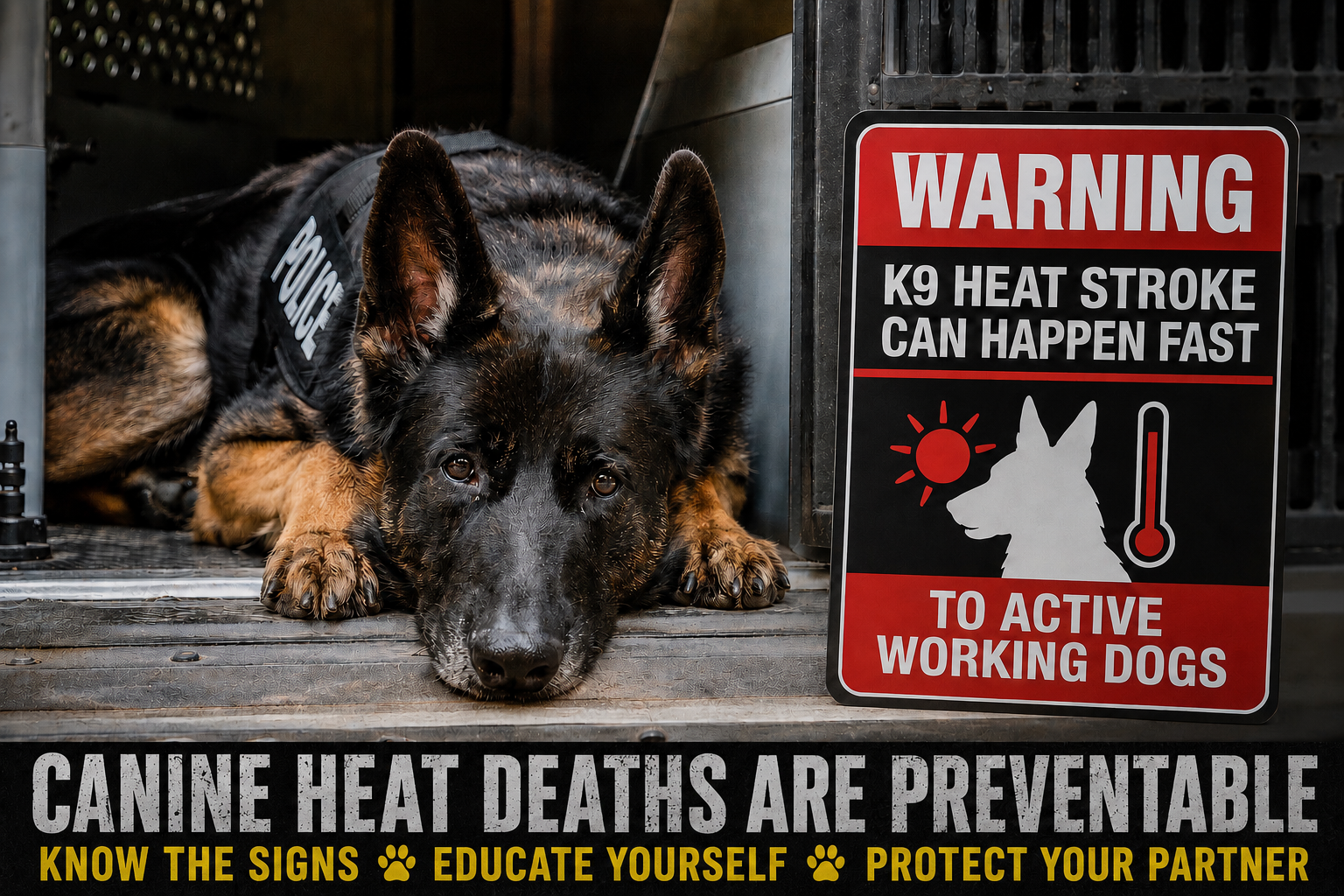
By the numbers, the total of ten law enforcement K-9 heatstroke deaths that occurred in 2025 fits right into the historical pattern — more than 2024, but less than 2023, and the same, on average, with the decade prior.
By the numbers, the total of ten law enforcement K-9 heatstroke deaths that occurred in 2025 fits right into the historical pattern — more than 2024, but less than 2023, and the same, on average, with the decade prior.
Still, there was a positive development: K-9 heatstroke deaths were more widely and forthrightly acknowledged by law enforcement agencies. This trend of quickly informing the public, and taking more explicit responsibility for these tragedies — most of them avoidable — is a step forward in actively addressing the problem.
2025 K-9 Heatstroke Deaths
As reported in public media
Kai4/23/25Bristol TN PDTraining
Scout5/27/25Suffolk VA PDTracking
Baxter5/28/25Maine DPSIn-vehicle
Henk6/21/25Helen GA PDTraining
Ender6/25/25Dorchester Cty. MD SheriffIn-vehicle
Sam7/8/25Lexington Cty. SC SheriffTraining
Georgia7/13/25Dade Cty. GA SheriffIn-vehicle
Karma8/8/25Isanti Cty. MN SheriffTracking
Archer9/4/25Hawai'i Cty. HI PDIn-vehicle
Cooper9/5/25Muskingum Cty. OH SheriffIn-vehicle
This year, two K-9s died while deployed in tracking, a primary duty of K-9 teams, with recognized risk. The other eight deaths were unrelated to law enforcement action. Three occurred during or soon after organized training events. Five K-9s perished while confined in a vehicle.
Whether deployed at their most instinctual tasks, exercising in-step with their beloved Handler, or secured per protocol inside their specially-equipped duty vehicle — that is to say, practically anywhere in the course of their typical daily activities — healthy K-9's are at risk of suddenly incurring heatstroke and dying. Just as ubiquitously true is that, no one is more shocked and heartbroken by a K-9's heatstroke death than their Handler.
A Hopeful Trend
By the numbers, 2025 K-9 heatstroke deaths and their causes persisted in line with the long-term trend. But important cultural progress was demonstrated by departments' public acknowledgement of most of this year's tragedies. In general the reports were met by immediate social media response that was broadly angry, but also to some extent, sympathetic. Most reports triggered a cascade of external and internal challenges.
Each death was investigated internally, and in some cases, externally. Several Handlers were charged and/or fired outright. Others were disciplined. Probably none will be assigned to police K-9 duty ever again.
The departments took their lumps — public outrage, internal penitence, the loss of the canine's unique policing skills, a disgraced officer, disrepute among K-9 unit funding and support institutions, etc.
Some departments undertook internal review of the policy and protocol failures that may have contributed to the tragedy. One department made their internal findings and corrections public, by declaring policy changes where gaps had been found deficient.
Accepting tough medicine is an important cultural change. Not long ago, most unnecessary K-9 deaths were kept quiet, and responsibility obscured. This tendency persists: one department made a concerted effort to obfuscate a K-9's in-vehicle death. While the officers involved eluded statutory consequence, the department finds itself months later still under a spotlight and still in civil jeopardy, while their oversight governance structure is embarrassed by their inability to implement meaningful accountability.
Acceptance is the First Step
Ultimately, 2025 was another bad year for K-9 heatstroke. But wider acknowledgement of unnecessary K-9 deaths by departments, even in the face of severe consequences, is becoming a strong impetus to finally start acting effectively against heatstroke risk in 2026.
K-9Cooler's mission to AVOID, ALLEVIATE, and PREVENT heat injury to working dogs has inspired development of active-principle products that are effective against heat injury. Visit our store to learn how the K-9 Heatstroke Emergency Field Kit can multiply your K-9's chance of surviving a serious heat injury episode, and save your department from the disgrace of an unnecessary K-9 death.
*Joshua Davidson is the Founder of K-9Cooler, which makes products to AVOID, ALLEVIATE, and PREVENT heat injury to working dogs, including the K-9 Heatstroke Emergency Field Kit.*
Browse all articles in
Medical and Safety
Explore more HITS resources
HITS regularly publishes podcast episodes, training updates, and educational content focused on operational readiness and courtroom defensibility in K9 work.