Legal Updates
Insights, discussions, and practical guidance related to
Legal Update
for law-enforcement K9 handlers, trainers, and supervisors. Articles in this category explore legal developments, operational considerations, and professional perspectives relevant to real K9 work.

Featured articles on
Legal Updates
Legal Update
0
min read
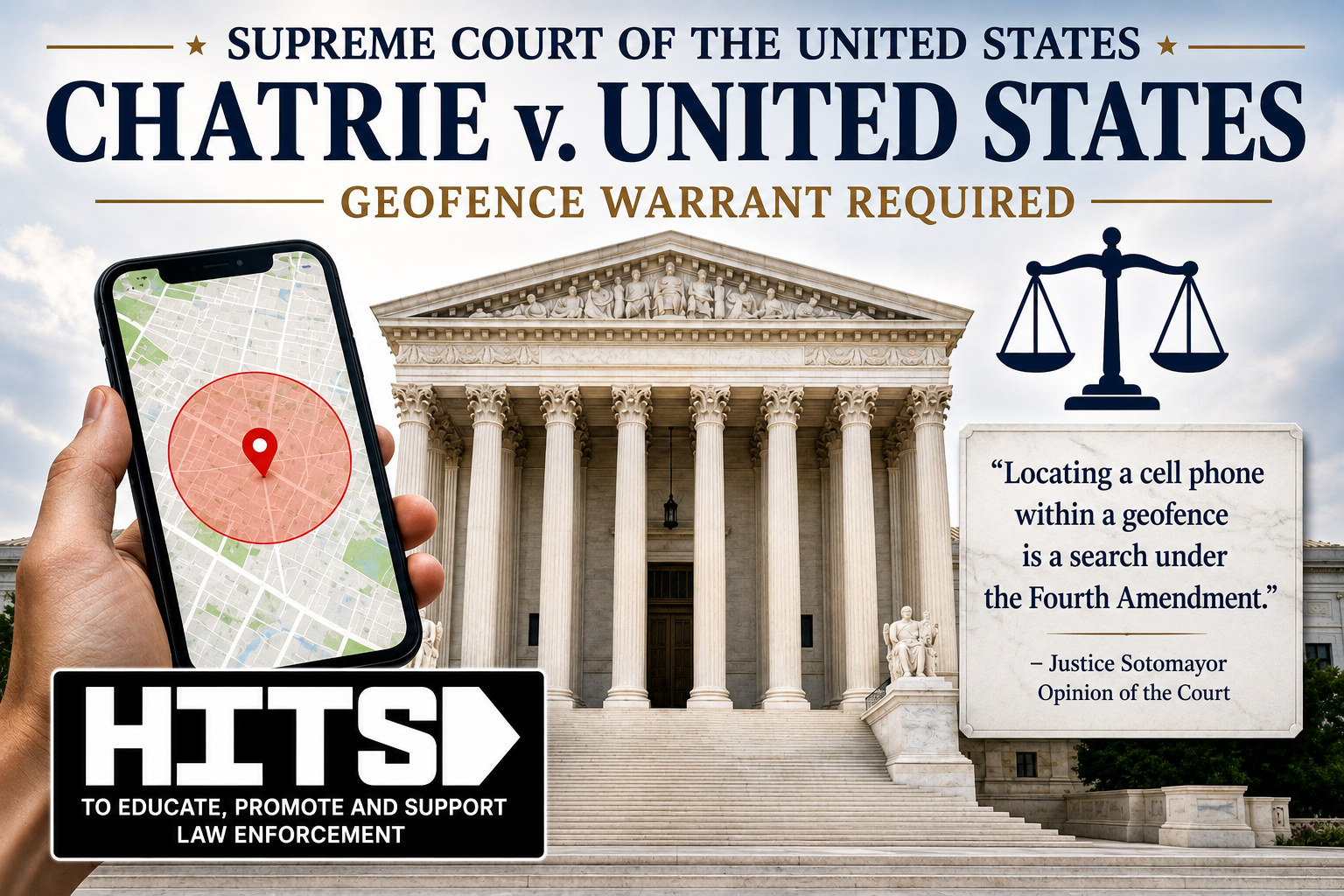
GEO Warrants - Chatrie v. United States
This summarizes the United States Supreme Court's decision in Chatrie v. United States, a landmark Fourth Amendment case addressing law enforcement's use of geofence warrants to obtain historical cell-phone location data from technology companies.
Facts of the Case
On May 20, 2019, a man robbed a credit union in Midlothian, Virginia. Investigators interviewed witnesses and reviewed surveillance video. The footage showed the suspect carrying and apparently using a cellular telephone before the robbery, but investigators were unable to identify the suspect through traditional investigative methods.
Detectives obtained a geofence warrant directed to Google. The warrant required Google to search its Location History database and identify every device located within approximately 150 meters of the credit union during the relevant time period.
The warrant operated in three stages:
- Google produced anonymized location data for every qualifying device within the geofence.
- Investigators narrowed the list based on movement patterns, and Google provided additional anonymous location data.
- After investigators identified several devices of interest, Google disclosed subscriber information associated with those accounts.
The investigation ultimately identified Okello Chatrie, whose movements were consistent with those of the robber. Additional investigation linked Chatrie to the robbery, and he was prosecuted in federal court.
Chatrie filed a Motion to Suppress the location data obtained through the geofence warrant, asserting that the obtaining of his cell phone location data was serch under the Fourth Amendment and that the warrant obtained by law enforcement lacked probable cause.
The District Court found that the geofence warrant "plainly violates the Fourth Amendment" but denied the Motion to Suppress based on the good-faith exception to the exclusionary rule. The Fourth Circuit Court of Appeals affirmed the District Court's ruling on different reasoning, holding that no search occurred because Chatrie "did not have a reasonable expectation of privacy in two hours ' worth of location history data voluntarily exposed to Google". The Supreme Court granted review solely on the question of whether the police violated the Fourth Amendment in obtaining Chatrie's location data.
Supreme Court Holding
On June 29, 2026, the Supreme Court held that law enforcement conducts a Fourth Amendment search when it acquires historical cell-phone location information through a geofence warrant from Google or any other provider. The court concluded that individuals maintain a reasonable expectation of privacy in their historical location information even when the information is stored by a third-party service provider such as Google. The court rejected the government's argument that users automatically lose Fourth Amendment protections simply because their location information is voluntarily shared with a technology company. Importantly, the Court did not decide whether the warrant used in Chatrie ultimately satisfied the Fourth Amendment's probable cause and particularity requirements. Instead, it remanded the case for further proceedings to determine whether the specific geofence warrant in this case met constitutional standards.
Officer Considerations
Officers Should recognize that:
- Accessing historical location data through a geofence warrant is now considered a Fourth Amendment search.
- Even though Google changed Location History in July 2025 so that data stored is stored on individual devices, other companies (Apple, Lyft, Uber, Snapchat, etc...) use location data and this decision extends to location data generally.
- Geofence warrants are subject to constitutional scrutiny including probable cause and particularity requirements
- A Geofence Warrant should be broken down into three separate warrants establishing probable cause for each step of the search.
- Investigators should expect closer judicial review of requests seeking location information involving multiple unknown individuals.
- Applications should be narrowly tailored in geographic scope, time period, and investigative necessity.
- Officers should consult prosecutors and legal advisors before seeking geofence warrants to ensure compliance with evolving constitutional standards.
Practical Impact
This decision does not prohibit geofence warrants. Instead, it requires courts to evaluate under traditional Fourth Amendment standards rather than treating the information as unprotected because it is held by a third party.
Investigators should anticipate increased judicial scrutiny and should ensure affidavits clearly articulate:
- the factual basis established probable cause;
- How the geographic area is related to the crime under investigation;
- That the requested time period is narrowly tailored to the information sought; and
- Why less intrusive methods, if available, would be insufficient to identify a suspect(s).

Legal Update
0
min read
USA v. Evans (3d Cir. 2026) May 19, 2026
Scope of a Search When Executing a Search Warrant. In United States v. Evans, officers obtained a warrant to search a New Jersey hotel room for evidence connecting its occupant to illegal firearms.
Scope of a Search When Executing a Search Warrant
USA v. Evans, (3d Cir. 2026) May 19th 2026
In United States v. Evans, officers obtained a warrant to search a New Jersey hotel room for evidence connecting its occupant to illegal firearms. During the search, a detective noticed a piece of broken ceiling tile sitting on the bed. Standing on the bed, he pressed on the damaged tile, causing a loaded pistol magazine to fall from the ceiling. Searching the area above the drop ceiling, officers recovered duffel bags containing drugs, cash, and other incriminating evidence.
Evans argued the search exceeded the warrant’s scope. The 3rd Circuit disagreed, holding the ceiling space was a reasonable place to search for the items listed in the warrant. The damaged ceiling, the fallen magazine, and Evans’ opportunity to access the area all supported the detective’s decision to search the ceiling cavity.
A search warrant authorizes officers to look anywhere the listed evidence could reasonably be hidden. As the U.S. Supreme Court explained in United States v. Ross (456 U.S. 798, 824 (1982)), the scope of a lawful search is defined by “the object of the search and the places in which there is probable cause to believe that it may be found.”
The principle is straightforward. A warrant for drugs, firearms, ammunition, cash, or documents may justify searching drawers, backpacks, crawlspaces … and the space above a drop ceiling. A warrant for a stolen refrigerator likely does not.
That’s precisely why the search in Evans was upheld. Firearm accessories and identifying evidence could reasonably have been hidden above the ceiling tiles.
Browse all articles in
Legal Updates
Explore more HITS resources
HITS regularly publishes podcast episodes, training updates, and educational content focused on operational readiness and courtroom defensibility in K9 work.