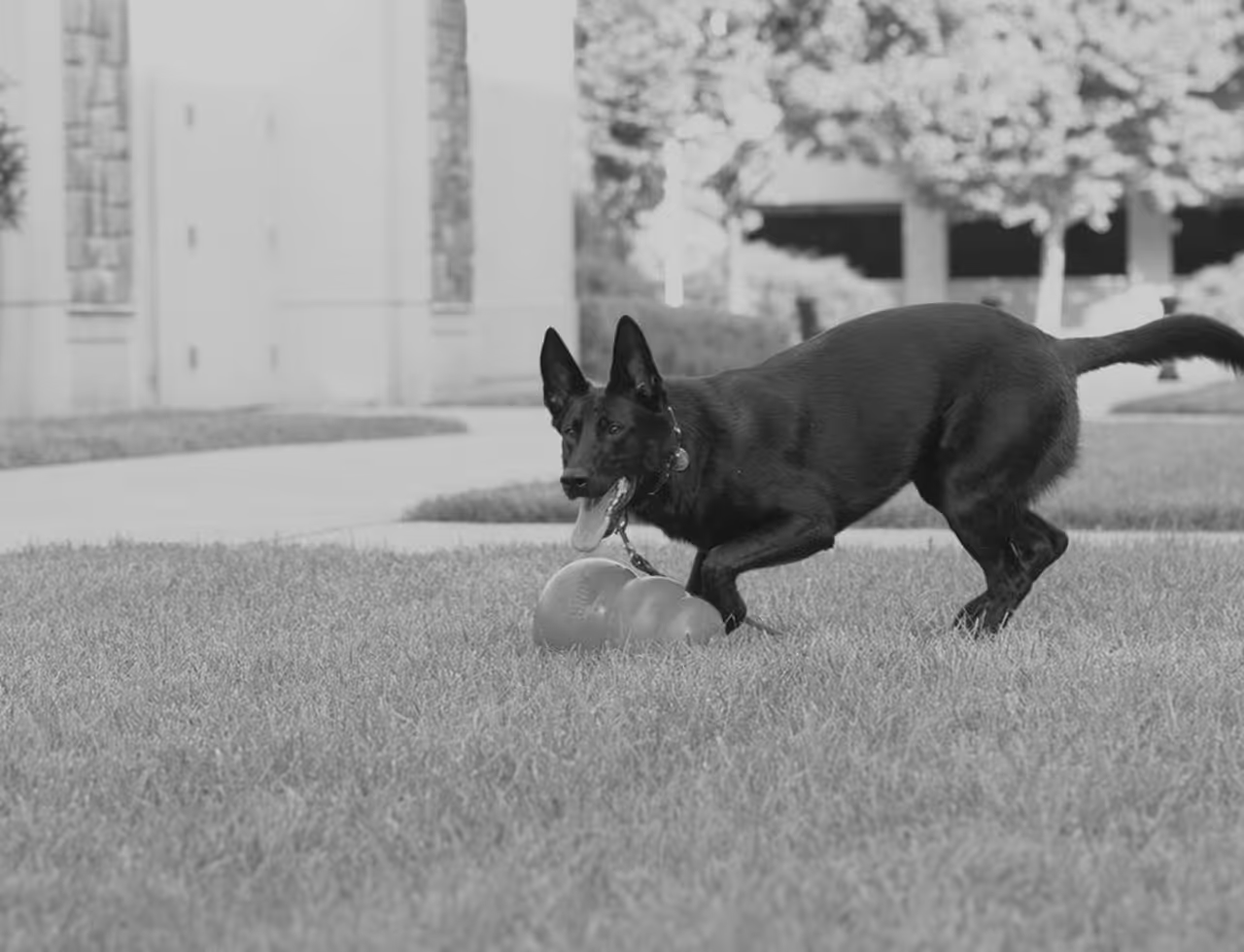
The Double Blind Training Trap
I periodically receive questions asking if the PACKTRACK record keeping system collects “double blind training” data. I was recently contacted by a new supervisor who was attending a class where this was discussed.
Andrew Weiman
25 June 2026
0
min read
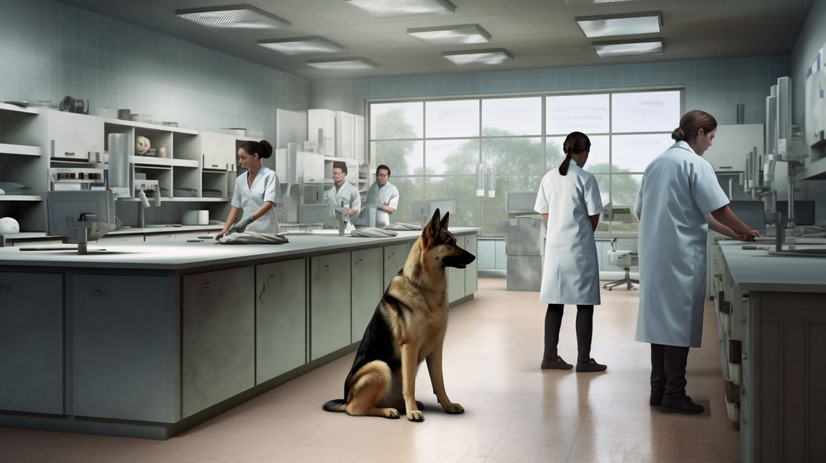
I periodically receive questions asking if the PACKTRACK record keeping system collects “double blind training” data. I was recently contacted by a new supervisor who was attending a class where this was discussed. It was his impression that the instructor was advocating for double blind training and that this was a necessary requirement to prove reliability. I can’t comment directly on the instruction as I wasn’t there. However, I do have considerable experience in this area. I’m also quite familiar with the views expressed by a range of defense experts, podcast authorities and trainers.
It’s easy to confuse the clinical definition of this topic with the practical application for police K9 training. In a double blind study, neither the participants nor the experimenters are aware of the test details. This helps eliminate bias and human influence. As a result, it’s considered the “gold standard” for scientific research. So why wouldn’t we use the same methodology for K9 training?
To properly explore this topic we need to start with a shared understanding of what “double blind” means in the context of police K9 training. Let’s see how it would work. In this type of training neither the handler nor the trainer can know:
• If the target odor is present
• Where the target odor is concealed
• The intended purpose or goal of the training exercise
Think about what this might mean for the quality of training that you and your K9 receive. By applying this rigid model, the handler and trainer:
• Don’t know if the final response was correct
• Don’t know if the target odor was missed
• Don’t know if the target odor was found using proper handling skills
• Don’t know why a target odor wasn’t found (was it the dog, the handler, the environment?)
• Can’t take corrective action at the appropriate time to effectively train and condition the behavior of the dog or the handler
This isn’t training, it’s shared ignorance. The timing of actions taken by the handler to correct or reinforce the behavior of the dog is critical to properly conditioning the canine. How are the handler, trainer and K9 supposed to improve under these conditions?
Rewarding or correcting a detection canine in an effective manner simply isn’t possible in a “double blind training” environment. Our goal is to train with intention and purpose. We want to correct or reinforce behaviors in a timely manner and push the handler and canine beyond their comfort zones. This is how we grow confidence and proficiency.
Please don’t misunderstand. I’m not against “double blind testing“. This is a very real activity that may be needed depending on the circumstances. However, “double blind training” just isn’t a thing. If you want to test yourself or your teams then please do so. Just don’t call it training.
Subscribe to our newsletter
Subscribe to receive the latest blog posts to your inbox every week.
By subscribing you agree to with our Privacy Policy.

More articles from the HITS blog
Legal Update
0
min read
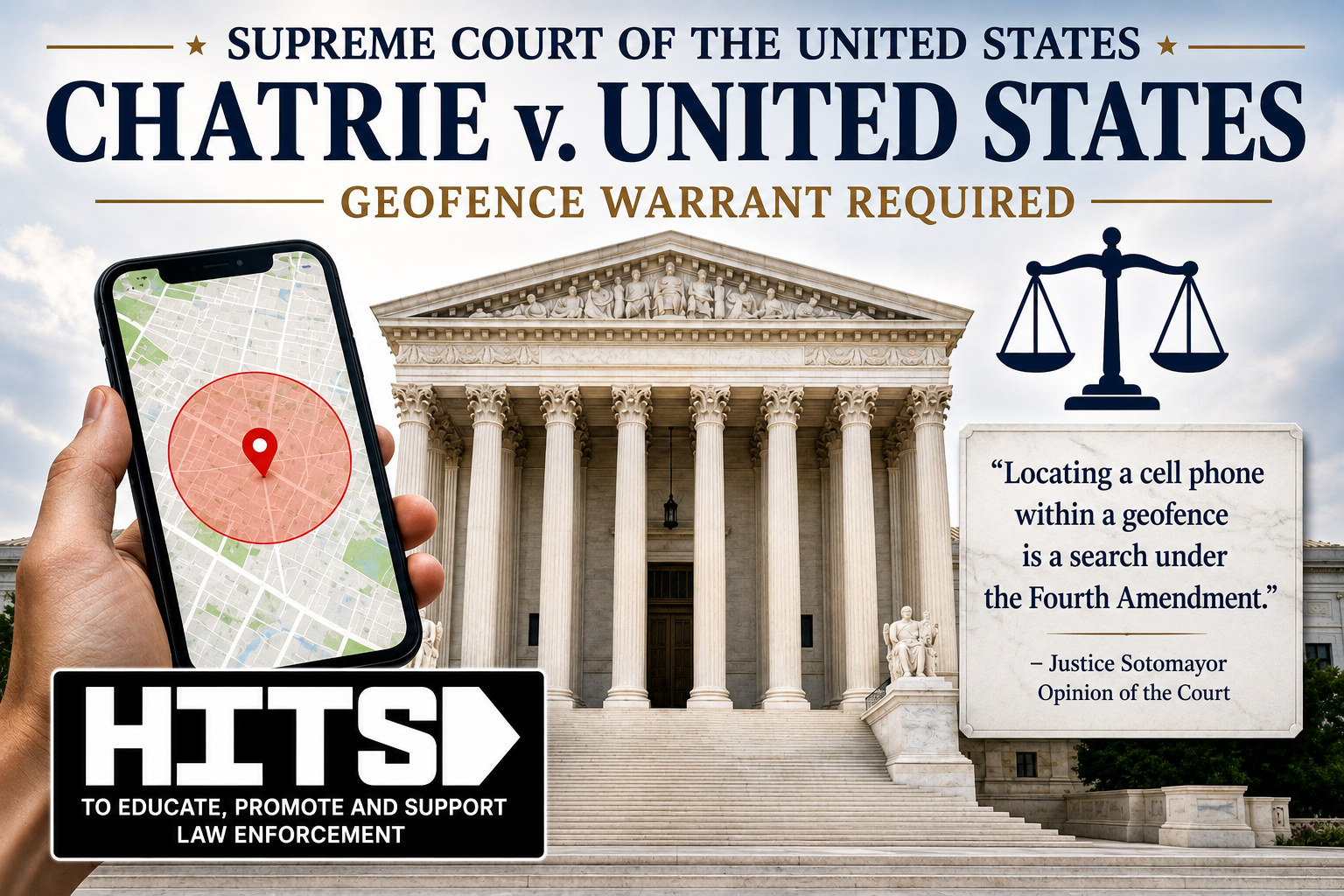
GEO Warrants - Chatrie v. United States
This summarizes the United States Supreme Court's decision in Chatrie v. United States, a landmark Fourth Amendment case addressing law enforcement's use of geofence warrants to obtain historical cell-phone location data from technology companies.
Facts of the Case
On May 20, 2019, a man robbed a credit union in Midlothian, Virginia. Investigators interviewed witnesses and reviewed surveillance video. The footage showed the suspect carrying and apparently using a cellular telephone before the robbery, but investigators were unable to identify the suspect through traditional investigative methods.
Detectives obtained a geofence warrant directed to Google. The warrant required Google to search its Location History database and identify every device located within approximately 150 meters of the credit union during the relevant time period.
The warrant operated in three stages:
- Google produced anonymized location data for every qualifying device within the geofence.
- Investigators narrowed the list based on movement patterns, and Google provided additional anonymous location data.
- After investigators identified several devices of interest, Google disclosed subscriber information associated with those accounts.
The investigation ultimately identified Okello Chatrie, whose movements were consistent with those of the robber. Additional investigation linked Chatrie to the robbery, and he was prosecuted in federal court.
Chatrie filed a Motion to Suppress the location data obtained through the geofence warrant, asserting that the obtaining of his cell phone location data was serch under the Fourth Amendment and that the warrant obtained by law enforcement lacked probable cause.
The District Court found that the geofence warrant "plainly violates the Fourth Amendment" but denied the Motion to Suppress based on the good-faith exception to the exclusionary rule. The Fourth Circuit Court of Appeals affirmed the District Court's ruling on different reasoning, holding that no search occurred because Chatrie "did not have a reasonable expectation of privacy in two hours ' worth of location history data voluntarily exposed to Google". The Supreme Court granted review solely on the question of whether the police violated the Fourth Amendment in obtaining Chatrie's location data.
Supreme Court Holding
On June 29, 2026, the Supreme Court held that law enforcement conducts a Fourth Amendment search when it acquires historical cell-phone location information through a geofence warrant from Google or any other provider. The court concluded that individuals maintain a reasonable expectation of privacy in their historical location information even when the information is stored by a third-party service provider such as Google. The court rejected the government's argument that users automatically lose Fourth Amendment protections simply because their location information is voluntarily shared with a technology company. Importantly, the Court did not decide whether the warrant used in Chatrie ultimately satisfied the Fourth Amendment's probable cause and particularity requirements. Instead, it remanded the case for further proceedings to determine whether the specific geofence warrant in this case met constitutional standards.
Officer Considerations
Officers Should recognize that:
- Accessing historical location data through a geofence warrant is now considered a Fourth Amendment search.
- Even though Google changed Location History in July 2025 so that data stored is stored on individual devices, other companies (Apple, Lyft, Uber, Snapchat, etc...) use location data and this decision extends to location data generally.
- Geofence warrants are subject to constitutional scrutiny including probable cause and particularity requirements
- A Geofence Warrant should be broken down into three separate warrants establishing probable cause for each step of the search.
- Investigators should expect closer judicial review of requests seeking location information involving multiple unknown individuals.
- Applications should be narrowly tailored in geographic scope, time period, and investigative necessity.
- Officers should consult prosecutors and legal advisors before seeking geofence warrants to ensure compliance with evolving constitutional standards.
Practical Impact
This decision does not prohibit geofence warrants. Instead, it requires courts to evaluate under traditional Fourth Amendment standards rather than treating the information as unprotected because it is held by a third party.
Investigators should anticipate increased judicial scrutiny and should ensure affidavits clearly articulate:
- the factual basis established probable cause;
- How the geographic area is related to the crime under investigation;
- That the requested time period is narrowly tailored to the information sought; and
- Why less intrusive methods, if available, would be insufficient to identify a suspect(s).
Medical and Safety
0
min read
K9 Heat Stroke - By the numbers
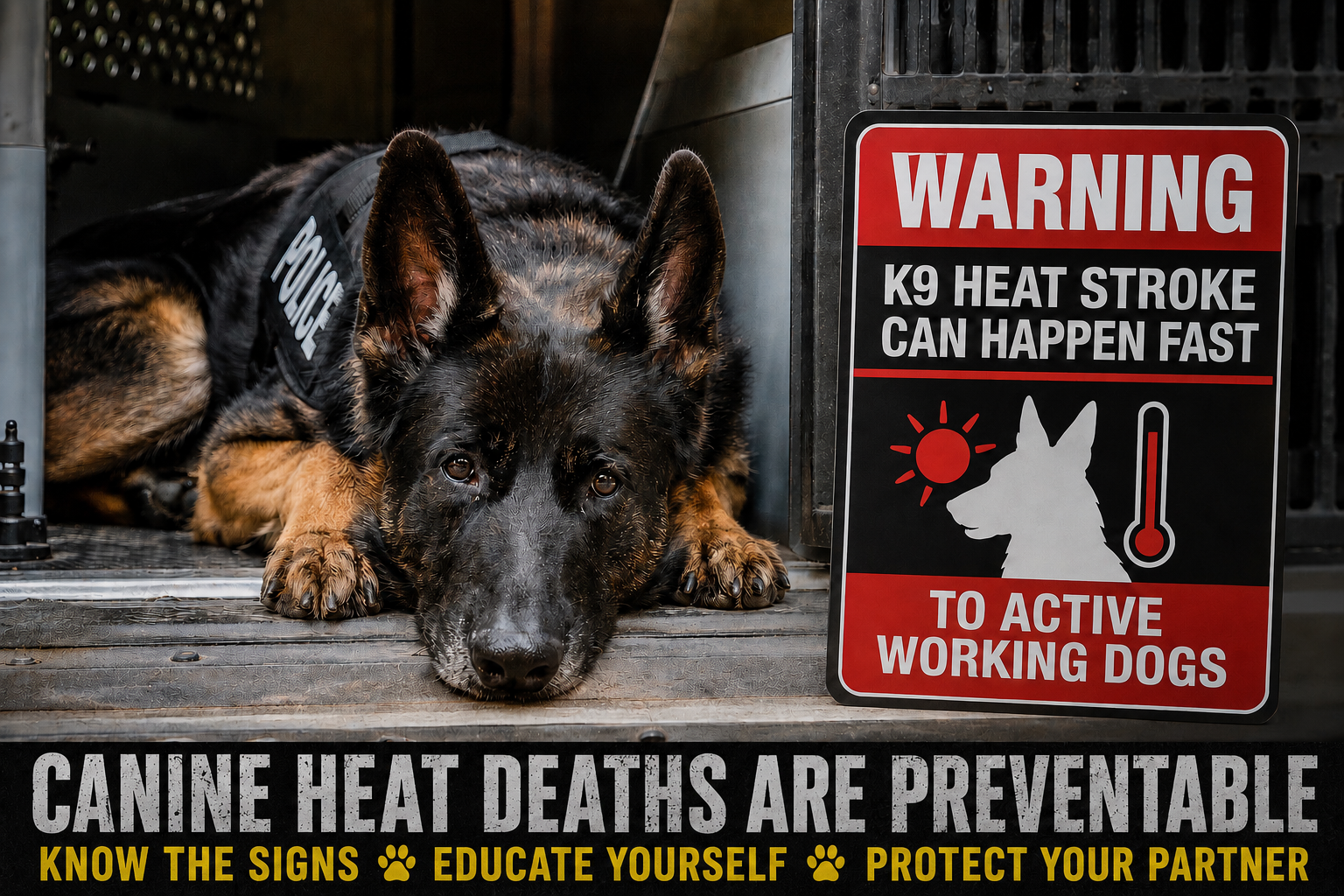
By the numbers, the total of ten law enforcement K-9 heatstroke deaths that occurred in 2025 fits right into the historical pattern — more than 2024, but less than 2023, and the same, on average, with the decade prior.
By the numbers, the total of ten law enforcement K-9 heatstroke deaths that occurred in 2025 fits right into the historical pattern — more than 2024, but less than 2023, and the same, on average, with the decade prior.
Still, there was a positive development: K-9 heatstroke deaths were more widely and forthrightly acknowledged by law enforcement agencies. This trend of quickly informing the public, and taking more explicit responsibility for these tragedies — most of them avoidable — is a step forward in actively addressing the problem.
2025 K-9 Heatstroke Deaths
As reported in public media
Kai4/23/25Bristol TN PDTraining
Scout5/27/25Suffolk VA PDTracking
Baxter5/28/25Maine DPSIn-vehicle
Henk6/21/25Helen GA PDTraining
Ender6/25/25Dorchester Cty. MD SheriffIn-vehicle
Sam7/8/25Lexington Cty. SC SheriffTraining
Georgia7/13/25Dade Cty. GA SheriffIn-vehicle
Karma8/8/25Isanti Cty. MN SheriffTracking
Archer9/4/25Hawai'i Cty. HI PDIn-vehicle
Cooper9/5/25Muskingum Cty. OH SheriffIn-vehicle
This year, two K-9s died while deployed in tracking, a primary duty of K-9 teams, with recognized risk. The other eight deaths were unrelated to law enforcement action. Three occurred during or soon after organized training events. Five K-9s perished while confined in a vehicle.
Whether deployed at their most instinctual tasks, exercising in-step with their beloved Handler, or secured per protocol inside their specially-equipped duty vehicle — that is to say, practically anywhere in the course of their typical daily activities — healthy K-9's are at risk of suddenly incurring heatstroke and dying. Just as ubiquitously true is that, no one is more shocked and heartbroken by a K-9's heatstroke death than their Handler.
A Hopeful Trend
By the numbers, 2025 K-9 heatstroke deaths and their causes persisted in line with the long-term trend. But important cultural progress was demonstrated by departments' public acknowledgement of most of this year's tragedies. In general the reports were met by immediate social media response that was broadly angry, but also to some extent, sympathetic. Most reports triggered a cascade of external and internal challenges.
Each death was investigated internally, and in some cases, externally. Several Handlers were charged and/or fired outright. Others were disciplined. Probably none will be assigned to police K-9 duty ever again.
The departments took their lumps — public outrage, internal penitence, the loss of the canine's unique policing skills, a disgraced officer, disrepute among K-9 unit funding and support institutions, etc.
Some departments undertook internal review of the policy and protocol failures that may have contributed to the tragedy. One department made their internal findings and corrections public, by declaring policy changes where gaps had been found deficient.
Accepting tough medicine is an important cultural change. Not long ago, most unnecessary K-9 deaths were kept quiet, and responsibility obscured. This tendency persists: one department made a concerted effort to obfuscate a K-9's in-vehicle death. While the officers involved eluded statutory consequence, the department finds itself months later still under a spotlight and still in civil jeopardy, while their oversight governance structure is embarrassed by their inability to implement meaningful accountability.
Acceptance is the First Step
Ultimately, 2025 was another bad year for K-9 heatstroke. But wider acknowledgement of unnecessary K-9 deaths by departments, even in the face of severe consequences, is becoming a strong impetus to finally start acting effectively against heatstroke risk in 2026.
K-9Cooler's mission to AVOID, ALLEVIATE, and PREVENT heat injury to working dogs has inspired development of active-principle products that are effective against heat injury. Visit our store to learn how the K-9 Heatstroke Emergency Field Kit can multiply your K-9's chance of surviving a serious heat injury episode, and save your department from the disgrace of an unnecessary K-9 death.
*Joshua Davidson is the Founder of K-9Cooler, which makes products to AVOID, ALLEVIATE, and PREVENT heat injury to working dogs, including the K-9 Heatstroke Emergency Field Kit.*

Legal Update
0
min read
USA v. Evans (3d Cir. 2026) May 19, 2026
Scope of a Search When Executing a Search Warrant. In United States v. Evans, officers obtained a warrant to search a New Jersey hotel room for evidence connecting its occupant to illegal firearms.
Scope of a Search When Executing a Search Warrant
USA v. Evans, (3d Cir. 2026) May 19th 2026
In United States v. Evans, officers obtained a warrant to search a New Jersey hotel room for evidence connecting its occupant to illegal firearms. During the search, a detective noticed a piece of broken ceiling tile sitting on the bed. Standing on the bed, he pressed on the damaged tile, causing a loaded pistol magazine to fall from the ceiling. Searching the area above the drop ceiling, officers recovered duffel bags containing drugs, cash, and other incriminating evidence.
Evans argued the search exceeded the warrant’s scope. The 3rd Circuit disagreed, holding the ceiling space was a reasonable place to search for the items listed in the warrant. The damaged ceiling, the fallen magazine, and Evans’ opportunity to access the area all supported the detective’s decision to search the ceiling cavity.
A search warrant authorizes officers to look anywhere the listed evidence could reasonably be hidden. As the U.S. Supreme Court explained in United States v. Ross (456 U.S. 798, 824 (1982)), the scope of a lawful search is defined by “the object of the search and the places in which there is probable cause to believe that it may be found.”
The principle is straightforward. A warrant for drugs, firearms, ammunition, cash, or documents may justify searching drawers, backpacks, crawlspaces … and the space above a drop ceiling. A warrant for a stolen refrigerator likely does not.
That’s precisely why the search in Evans was upheld. Firearm accessories and identifying evidence could reasonably have been hidden above the ceiling tiles.
Stay informed on new training and insights
Stay informed about upcoming HITS training events, new articles, and podcast conversations.