

Why Dogs "Disobey", How Context and Conditioning Control Behavior
This class explains how context and past training shape a dog’s expectations and behavior, even when no command is given. We will show how environmental cues and repeated training setups prepare the dog’s brain for specific actions.

Class overview
Handlers will learn why many training failures are not true disobedience, but the result of conflicting expectations or strongly conditioned responses. We will examine how classical conditioning, anticipation, and context can either support performance or create conflict between the dog and handler. The goal is to help handlers understand how dogs process information, so they can design training and handling strategies that reduce conflict, increase clarity, and improve consistency in real-world performance.
Handlers will learn why many training failures are not true disobedience, but the result of conflicting expectations or strongly conditioned responses. We will examine how classical conditioning, anticipation, and context can either support performance or create conflict between the dog and handler. The goal is to help handlers understand how dogs process information, so they can design training and handling strategies that reduce conflict, increase clarity, and improve consistency in real-world performance.
This session explains:
- why many training failures are not true disobedience, but the result of conflicting expectations or strongly conditioned responses.
- We will examine how classical conditioning, anticipation, and context can either support performance or create conflict between the dog and handler.
- The goal is to help handlers understand how dogs process information, so they can design training and handling strategies that reduce conflict
- why many training failures are not true disobedience
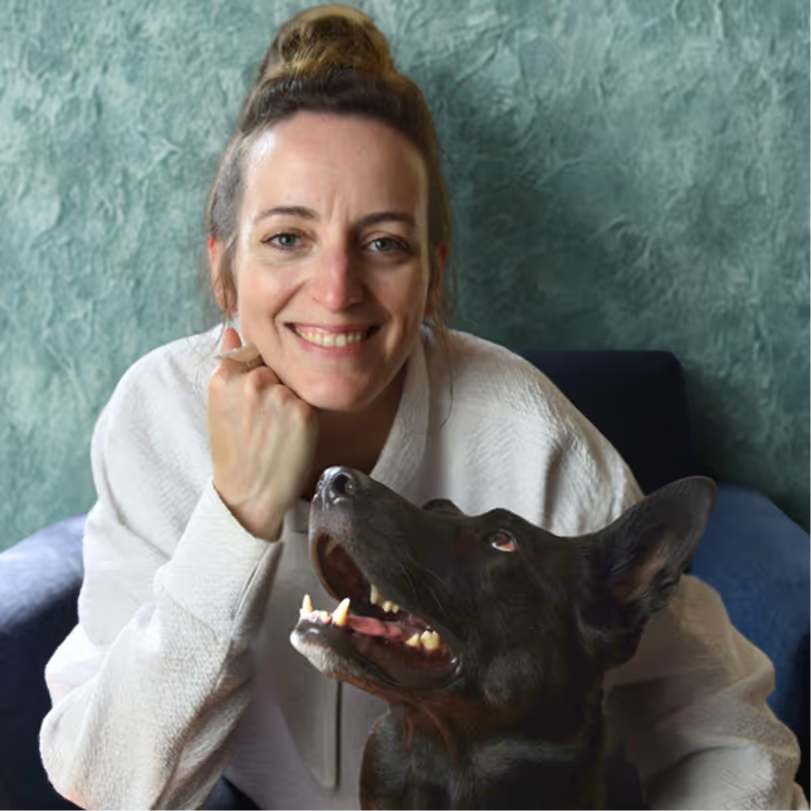
Dr. Melanie Uhde
Dr. Melanie Uhde holds a Ph.D. in Biology from the Bernhard-Nocht-Institute for Tropical Medicine in Germany and completed postdoctoral research at Columbia University, focusing on brain–body interactions relevant to behavior and stress.
She has authored 16 peer-reviewed scientific publications and completed advanced studies in anxiety disorders at Stanford University. In parallel with her academic work, she has over a decade of hands-on dog training experience, actively trains in protection sport with her own Malinois, and is a Certified Canine Athlete Specialist with a focus on physical resilience and longevity. Her work bridges neuroscience and applied training to better understand how motivation and resilience are built, expressed, and regulated in dogs.
What past attendees say
"To the organizers of Handler Instruction & Training Seminar 2026,I was an exhibitor for K9 Tactical Gear Inc at Handler Instruction & Training Seminar 2026. I wanted to express my thanks and appreciation for putting together such a successful event. I had a great experience exhibiting, and everything felt well thought out and organized. I know these events require a lot of hard work behind the scenes, and it showed in how smoothly everything went.Whova was also a great tool to use throughout the event. I relied on it to see who was attending, get updates, and strike up conversations with potential leads. It definitely enhanced my overall experience and helped me make the most out of being an Exhibitor.Best regards,Susan Forbes, K9 Tactical Gear"

"I helped run Twin Oaks Manufacturing’s booth at this event and had such a great time! I especially liked being able to manage our booth profile, see the event schedule, and coordinate demos all through Whova. We had steady traffic and great conversations. Everything ran beautifully, thank you!
"I was part of the Elite Nutrition team and really enjoyed this event, everything was so organized! Having exhibit hall hours and getting live updates in Whova was great. I was never worried I was missing something. We met a lot of attendees and had a fantastic experience. Thanks for hosting!
"Lorem ipsum dolor sit amet, consectetur adipiscing elit. Suspendisse varius enim in eros elementum tristique. Duis cursus, mi quis viverra ornare."
"Lorem ipsum dolor sit amet, consectetur adipiscing elit. Suspendisse varius enim in eros elementum tristique. Duis cursus, mi quis viverra ornare."
"Lorem ipsum dolor sit amet, consectetur adipiscing elit. Suspendisse varius enim in eros elementum tristique. Duis cursus, mi quis viverra ornare."
Secure your seat at HITS 2026
Legal defensibility is not theoretical. It is tested in court.
This class helps handlers and agencies prepare before that moment arrives.

Explore other HITS classes
The Drug Canine Legal Update is one part of a broader HITS program designed to strengthen deployment judgment, detection reliability, and operational decision-making in the field. Additional sessions expand that learning across tracking, behavior, detection science, and tactical leadership.